Let’s Crack CET 2027

Log in to track · your CET progress

TSPM – MBA CET questions with solutions

6 questions · CET 2025–2026 · Easy 4 · Medium 2 · Hard 0. Newest paper first. Full papers

Q160EasyCET 2026 · Attempt 2 Slot 2 · Q160

Passage shown as image

Select the most suitable title for this passage.
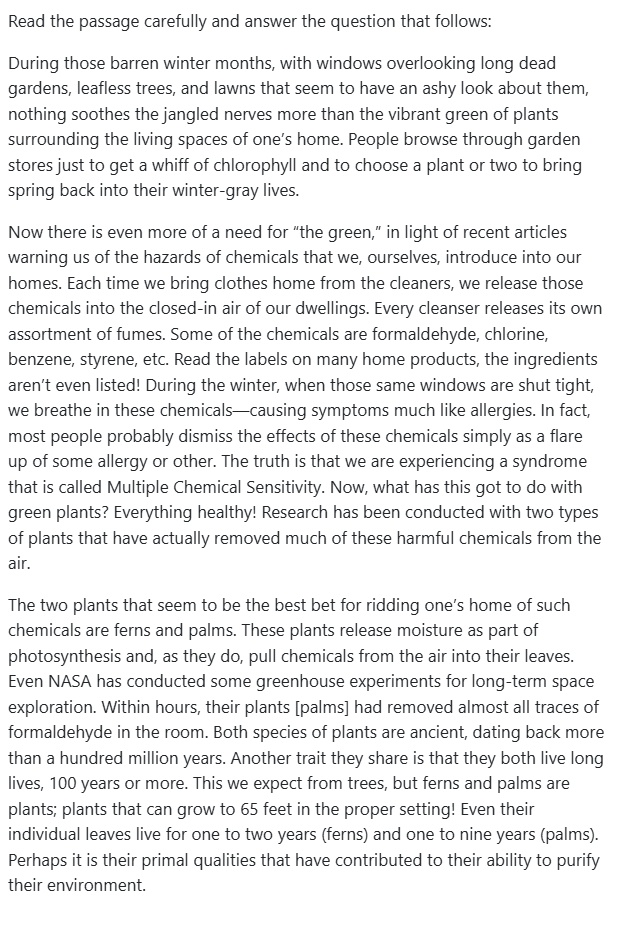
Figure for MBA CET 2026 Attempt 2 Slot 2 question 160
  1. Research in the New Millennium.
  2. Home Dangers.
  3. Common Houseplants May Purify Your Home.
  4. NASA Experiment Finds the Cure.
  5. The pitfalls of hazardous chemicals.
Show answerHide answer

Answer: C official key

Approach: Title — must cover the passage's main point, neither too narrow nor too broad.

Solution: The passage moves from the hazards of indoor chemicals to its real point: ferns and palms (common houseplants) can pull these chemicals from the air. 'Common Houseplants May Purify Your Home' captures both the subject and the claim, with an appropriately tentative 'may' (the author says 'perhaps', 'seem to be').

Why the other options are wrong:
A: Too broad and vague.
B, E: Cover only the problem half.
D: 'Finds the Cure' overstates; NASA is a single supporting example.

Cetking shortcut: Title = main idea in headline form; reuse your answer to the main-idea question (D).

Answer: C
Q161EasyCET 2026 · Attempt 2 Slot 2 · Q161

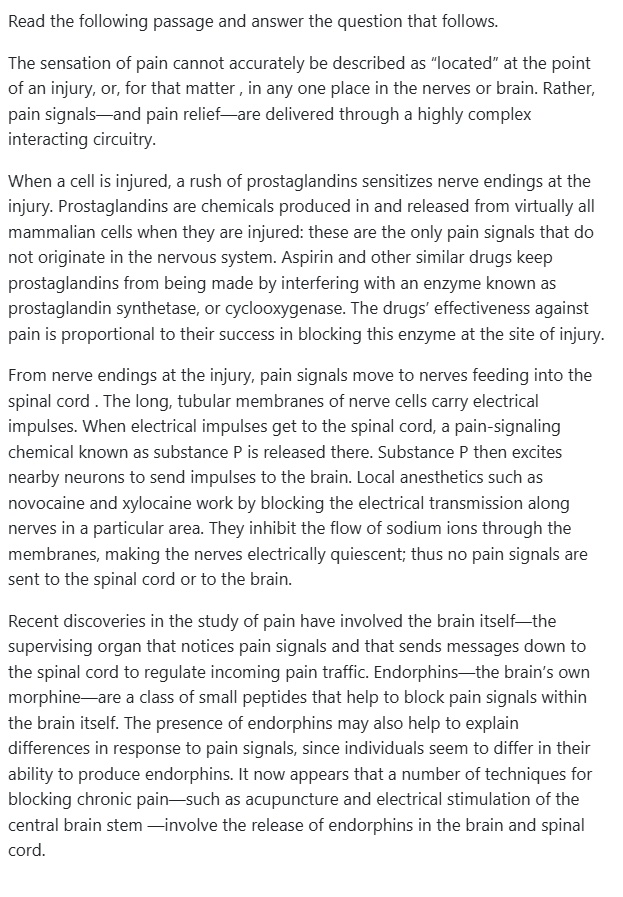
Passage shown as image

The passage is concerned with which of the following theme completely?

Figure for MBA CET 2026 Attempt 2 Slot 2 question 161
  1. analyzing ways that enzymes and other chemicals influence how the body feels pleasure and pain
  2. describing the presence of endorphins in the brain and discussing ways it is harmful to the body
  3. describing how pain signals are conveyed in the body and discussing ways in which the pain signals can be blocked
  4. demonstrating that pleasure can be influenced by acupuncture and electrical stimulation of the central brain stem
  5. differentiating the kinds of pain that occur at different points in the body's nervous system
Show answerHide answer

Answer: C official key

Approach: Primary purpose — the option must cover the whole passage.

Solution: Para 1: pain travels through complex circuitry. Para 2: prostaglandins sensitise nerve endings; aspirin blocks their synthesis. Para 3: impulses go to the spinal cord, substance P relays them; local anaesthetics block transmission. Para 4: endorphins block signals in the brain. So the passage describes how pain signals are conveyed and the ways they can be blocked — option C.

Why the other options are wrong:
A: 'Pleasure' is never discussed.
B: Endorphins help the body — the passage never calls them harmful.
D: Acupuncture blocks pain; pleasure is not mentioned.
E: The passage is about one signal pathway, not 'kinds' of pain.

Cetking shortcut: 'Completely' in the stem = the option must cover both halves (transmission + blocking).

Answer: C

Q166EasyCET 2026 · Attempt 2 Slot 2 · Q166

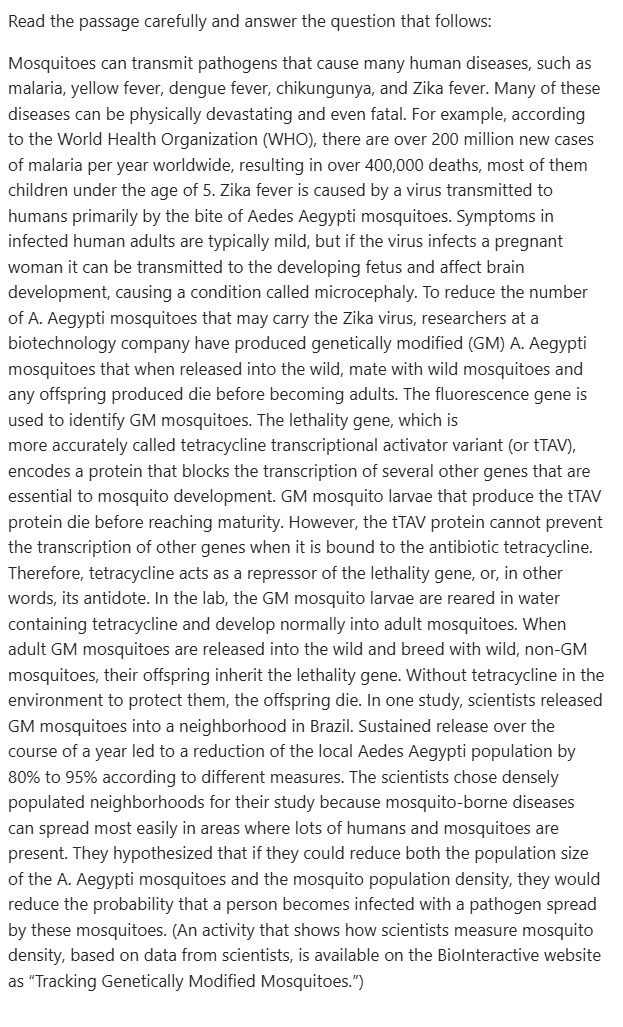
Passage shown as image

Which of the following is a suitable title for the passage?

Figure for MBA CET 2026 Attempt 2 Slot 2 question 166
  1. Mosquitoes and Zika virus
  2. Genetically modified mosquitoes
  3. Symptoms of mosquito-borne diseases
  4. The connection between Brazil and mosquitoes
  5. The mosquitoes and the honey bees
Show answerHide answer

Answer: B official key

Approach: Title — find what most of the passage discusses.

Solution: Diseases and Zika are only the opening context. The bulk of the passage explains how GM A. aegypti mosquitoes are made (lethality gene tTAV, fluorescence gene, tetracycline antidote), how their offspring die, and the Brazil release that cut the population by 80–95%. Title: 'Genetically modified mosquitoes'.

Why the other options are wrong:
A: Zika is only the motivation, too narrow.
C: Symptoms take one line.
D: Brazil is only the study site.
E: Honey bees are never mentioned.

Answer: B

Q168MediumCET 2025 · Slot 1 · Q168
Passage / data for this question

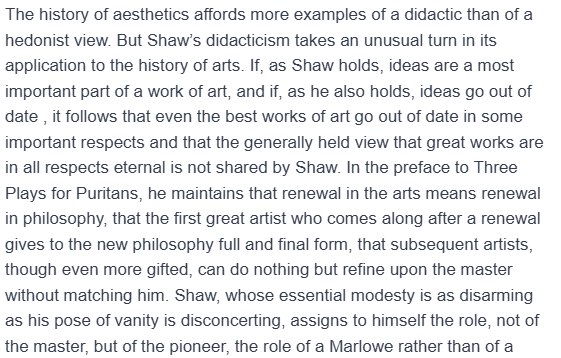
Reading Comprehension passage — shown as image.

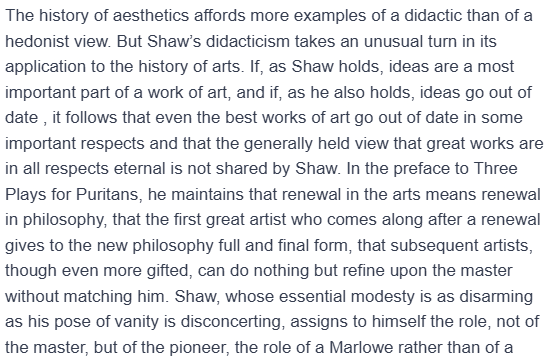
The author sets off the word “pure” with quotation marks in order to :
Figure for MBA CET 2025 Slot 1 question 168Figure for MBA CET 2025 Slot 1 question 168Figure for MBA CET 2025 Slot 1 question 168
  1. Option A
  2. Option B
  3. Option C
  4. Option D
  5. Option E
Show answerHide answer

Answer: A

Approach: Purpose of punctuation: why the author puts quotation marks around 'pure'.

Solution: The author writes 'the errors of "pure" art and of commercialized art are identical' and then says 'True art, on the other hand, is not merely a matter of pleasure'. The quotation marks show that so-called pure art (Art for Art's Sake) is not genuinely pure, which sets it against the true art Shaw values.

Why the other options are wrong:
B: the quotes add a negative tone; they do not strip one away.
C: the passage equates the errors of the two, not the words themselves.
D, E: the quotes are sceptical, not emphatic or approving.

Cetking shortcut: Quotation marks around an approving word usually mean 'so-called'; look for the contrasting word nearby ('True').

Answer: A

Q170EasyCET 2025 · Slot 1 · Q170
Passage / data for this question

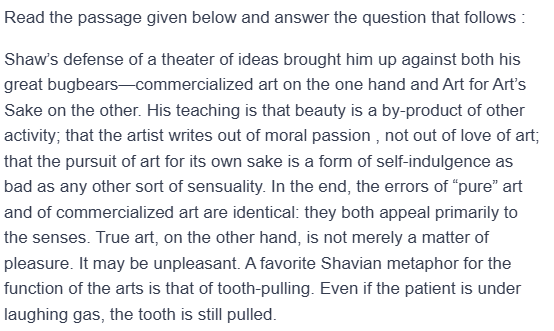
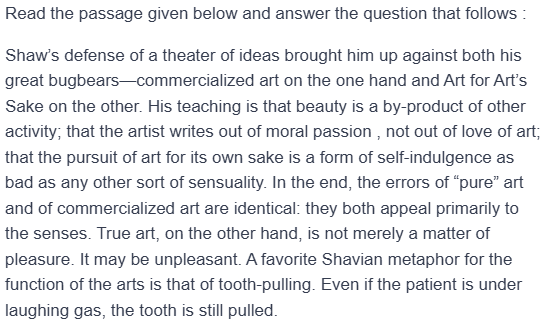
Reading Comprehension passage — shown as image.

According to the author, Shaw compares art to tooth-pulling in order to show that :
Figure for MBA CET 2025 Slot 1 question 170Figure for MBA CET 2025 Slot 1 question 170Figure for MBA CET 2025 Slot 1 question 170
  1. Option A
  2. Option B
  3. Option C
  4. Option D
  5. Option E
Show answerHide answer

Answer: D

Approach: Purpose of an analogy.

Solution: The analogy sits right after 'True art… is not merely a matter of pleasure. It may be unpleasant.' Even under laughing gas (some pleasure), the tooth is still pulled (the real, possibly painful, purpose). So art's purpose goes beyond pleasure.

Why the other options are wrong:
A: a lasting effect is not the point of the analogy.
B: dating of art belongs to the next paragraph.
C: extracting moral relevance from an epoch is not stated.
E: 'may be unpleasant' does not mean art is always painful.

Cetking shortcut: Read the sentence just before the analogy; it states the point the analogy illustrates.

Answer: D

Q174MediumCET 2025 · Slot 1 · Q174

I eschew the notion of racial kinship. I do so in order to claim what Michael Sandel calls the unencumbered self: an individual who chooses aims and attachments rather than accepting them simply because of custom, tradition or inherited status. On this view, the self is the author of the obligations it chooses to recognise.

Sandel objects that such a self is an illusion. Certain obligations of solidarity, religion and community bind us for reasons unrelated to a choice. Family and community connections formed in childhood, loyalties inherited from the past, and membership of a nation or people help constitute who we are. We understand ourselves partly as bearers of a particular history, not merely as independent choosers. Racial kinship is one expression of this conception of an encumbered self.

I recognise a virtue in this account: it can affirm the value of a people whose worth has been denied by prejudice. Yet that does not establish that inherited membership should determine a person's identity or achievement. What should properly be the object of pride for an individual is what that individual has chosen and accomplished, not an achievement credited to them merely because others of the same ancestry performed it.

This distinction supports my objection to racial solidarity as an overriding claim upon the individual. Respect for other people does not require treating their ancestry as one's own accomplishment. The disagreement is therefore about identity: whether we define ourselves primarily through inherited family, history and culture or through our own choices and independent accomplishments.

Why does the author define “what should properly be the object of pride for an individual”?
  1. To conceal agreement with Sandel’s criticism of the unencumbered self.
  2. To explain how racial connections guarantee professional rewards.
  3. To undermine the ideal of a freely choosing individual.
  4. To argue that individual accomplishments are determined entirely by ancestry.
  5. To lay the foundation for the argument against racial solidarity as an overriding claim on the individual.
Show answerHide answer

Answer: E

Solution: The definition separates personal accomplishment from inherited group membership. The following paragraph uses that distinction to reject racial solidarity as an overriding obligation. It supports the author’s position, rather than Sandel’s opposing view.

Answer: E

Practise these in the Arena

Take timed tests built around MBA CET topics and see where you stand.

Open the Arena

What next

Admit cards · CAT admit card · © Cetking Universe · Terms & Privacy · By using this site, you agree to Cetking's Terms.