Ages + Ratios When Rajesh’s age was same as the present age of Garima, the ratio of their ages was 3 : 2. When Garima’s age becomes the same as the present age of Rajesh, the ratio of the ages of Rajesh and Garima will become
1) 2 : 1 2) 3 : 2 3) 4 : 3 4) 5 : 4
SolutionAge Ratio Problem
Let the ages when Rajesh was Garima's current age be:
Rajesh = \( 3x \), Garima = \( 2x \)
Since this was when Rajesh's age matched Garima's current age:
Garima's current age = \( 3x \)
Age difference between them = \( 3x - 2x = x \)
So, Rajesh’s current age = \( 3x + x = 4x \)
Now, when Garima becomes as old as Rajesh is now (i.e., \( 4x \)), time passed = \( 4x - 3x = x \) years
So, at that time:
- Garima's age = \( 3x + x = 4x \)
- Rajesh's age = \( 4x + x = 5x \)
Hence, the required ratio = \( \frac{5x}{4x} = \frac{5}{4} \)
Final Answer: Option 4) \( \boxed{5 : 4} \)
Mixtures + Percentages + Ratios A vessel contained a certain amount of a solution of acid and water. When 2 litres of water was added to it, the new solution had 50% acid concentration. When 15 litres of acid was further added to this new solution, the final solution had 80% acid concentration. The ratio of water and acid in the original solution was
1) 5 : 4 2) 5 : 3 3) 3 : 5 4) 4 : 5
SolutionAcid-Water Solution Ratio
Find the Ratio of Water to Acid in the Original Solution
Let:
\( A \) = original amount of acid in litres
\( W \) = original amount of water in litres
Step 1: After adding 2 litres of water
New water = \( W + 2 \), acid remains \( A \)
New total = \( A + W + 2 \)
Given: 50% acid concentration:
\[
\frac{A}{A + W + 2} = \frac{1}{2}
\Rightarrow 2A = A + W + 2
\Rightarrow A = W + 2 \tag{1}
\]
Step 2: Add 15 litres of acid
New acid = \( A + 15 \), water = \( W + 2 \), total = \( A + W + 17 \)
From (1): \( A = W + 2 \)
Substituting into (2):
\[
(W + 2) - 4W = -7
\Rightarrow -3W + 2 = -7
\Rightarrow -3W = -9
\Rightarrow W = 3
\]
\[
\Rightarrow A = 3 + 2 = 5
\]
✅ Final Answer: The ratio of water to acid in the original solution is \( \boxed{3 : 5} \)
Logs + Maxima
Logarithm Expression Problem
If \( a, b, c \) are positive real numbers such that:
\[
a > 10 \geq b \geq c \quad \text{and} \quad
\frac{\log_8(a + b)}{\log_2 c} + \frac{\log_{27}(a - b)}{\log_3 c} = \frac{2}{3}
\]
Then the greatest possible integer value of \( a \) is?
SolutionGreatest Integer Value of a
Problem:
If \( a, b, c \) are positive real numbers such that:
\( a > 10 \geq b \geq c \), and
\[
\frac{\log_8(a + b)}{\log_2 c} + \frac{\log_{27}(a - b)}{\log_3 c} = \frac{2}{3},
\]
then find the greatest possible integer value of \( a \).
Step 1: Change of Base
Using \( \log_b x = \frac{\log_k x}{\log_k b} \):
\[
\log_8(a + b) = \frac{\log_2(a + b)}{\log_2 8} = \frac{\log_2(a + b)}{3}, \quad
\log_{27}(a - b) = \frac{\log_3(a - b)}{3}
\]
So the given equation becomes:
\[
\frac{1}{3} \cdot \frac{\log_2(a + b)}{\log_2 c} + \frac{1}{3} \cdot \frac{\log_3(a - b)}{\log_3 c} = \frac{2}{3}
\]
Multiply both sides by 3:
\[
\frac{\log_2(a + b)}{\log_2 c} + \frac{\log_3(a - b)}{\log_3 c} = 2
\]
Step 2: Convert to Single Log Base
Using \( \frac{\log_b x}{\log_b y} = \log_y x \), we get:
\[
\log_c(a + b) + \log_c(a - b) = 2
\]
Using log product rule:
\[
\log_c\left((a + b)(a - b)\right) = \log_c(a^2 - b^2) = 2
\]
Hence:
\[
a^2 - b^2 = c^2 \Rightarrow a^2 = b^2 + c^2
\]
Step 3: Maximize \( a \) under Constraint
Since \( 10 \geq b \geq c \), the maximum value of \( a \) will occur when both \( b \) and \( c \) are largest possible.
Let:
\[
b = 10, \quad c = 10
\]
Then:
\[
a^2 = 10^2 + 10^2 = 200 \Rightarrow a = \sqrt{200} = 10\sqrt{2} \approx 14.14
\]
Final Answer:
The greatest possible integer value of \( a \) is:
\[
\boxed{14}
\]
Percentages + Averages + Equations A company has 40 employees whose names are listed in a certain order. In the year 2022, the average bonus of the first 30 employees was Rs. 40,000, of the last 30 employees was Rs. 60,000, and of the first 10 and last 10 employees together was Rs. 50,000. Next year, the average bonus of the first 10 employees increased by 100%, of the last 10 employees increased by 200% and of the remaining employees was unchanged. Then, the average bonus, in rupees, of all the 40 employees together in the year 2023 was
1) 85000 2) 95000 3) 80000 4) 90000
SolutionBonus Distribution Explanation
Bonus Distribution Explanation (HTML + MathJax)
Let the total bonus of the first 10 employees be \( F \), and the last 10 employees be \( L \).
Step 1: Using first 30 and last 30 employee data
\[
\text{Total bonus} = 30 \times 40{,}000 + L = 12{,}00{,}000 + L \tag{1}
\]
\[
\text{Total bonus} = 30 \times 60{,}000 + F = 18{,}00{,}000 + F \tag{2}
\]
Equating (1) and (2):
\[
12{,}00{,}000 + L = 18{,}00{,}000 + F \Rightarrow L - F = 6{,}00{,}000 \tag{3}
\]
Step 2: Using first 10 and last 10 employee data
\[
\frac{F + L}{20} = 50{,}000 \Rightarrow F + L = 10{,}00{,}000 \tag{4}
\]
Substituting from (3): \( L = F + 6{,}00{,}000 \) into (4):
\[
F + (F + 6{,}00{,}000) = 10{,}00{,}000 \Rightarrow 2F = 4{,}00{,}000 \Rightarrow F = 2{,}00{,}000
\]
\[
\Rightarrow L = 8{,}00{,}000
\]
Step 3: Middle 20 employee bonus
\[
\text{Total for first 30} = 30 \times 40{,}000 = 12{,}00{,}000
\Rightarrow \text{Middle 20} = 12{,}00{,}000 - F = 10{,}00{,}000
\]
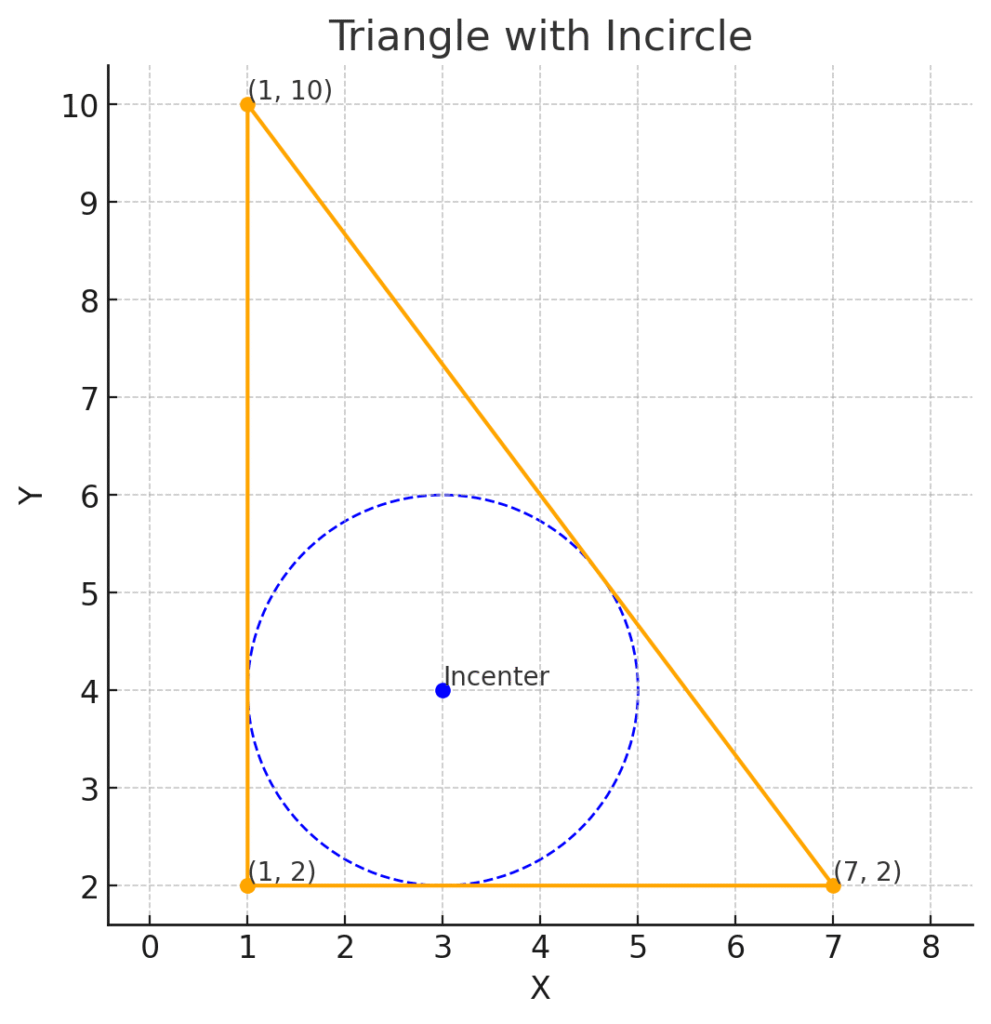
Coordinate + InCircle The coordinates of the three vertices of a triangle are: (1, 2), (7, 2), and (1, 10). Then the radius of the in circle of the triangle is ________
SolutionInradius of Triangle
Problem:
The coordinates of the vertices of a triangle are: \( (1, 2), (7, 2), (1, 10) \).
Find the radius of the incircle of the triangle.
Solution:
When plotted, the triangle clearly forms a right-angled triangle with the right angle at point \( (1, 2) \).
This is because two sides are aligned along the x-axis and y-axis.
Let side \( a \) be the vertical leg:
\[
a = 10 - 2 = 8
\]
Let side \( b \) be the horizontal leg:
\[
b = 7 - 1 = 6
\]
Using the Pythagorean Theorem:
\[
\text{Hypotenuse } h = \sqrt{a^2 + b^2} = \sqrt{8^2 + 6^2} = \sqrt{64 + 36} = \sqrt{100} = 10
\]
The inradius of a right triangle is given by:
\[
r = \frac{a + b - h}{2}
\]
Substituting the values:
\[
r = \frac{8 + 6 - 10}{2} = \frac{4}{2} = 2
\]
Final Answer:
The radius of the incircle is: \( \boxed{2} \)
Profit Loss + Percentages Bina incurs 19% loss when she sells a product at Rs. 4,860 to Shyam, who in turn sells this product to Hari. If Bina would have sold this product to Shyam at the purchase price of Hari, she would have obtained 17% profit. Then, the profit, in rupees, made by Shyam is _______
SolutionProfit Made by Shyam
Problem:
Bina incurs a 19% loss when she sells a product at Rs. 4,860 to Shyam, who in turn sells this product to Hari.
If Bina would have sold this product to Shyam at the purchase price of Hari, she would have obtained a 17% profit.
Then, the profit, in rupees, made by Shyam is:
Solution:
Let the cost price of the product for Bina be \( x \).
Given she sold it to Shyam at a 19% loss:
\[
4860 = x \times (1 - 0.19) = 0.81x
\]
Solving:
\[
x = \frac{4860}{0.81} = 6000
\]
So, Bina's cost price was Rs. 6000.
If Bina had sold it at Hari's purchase price and made a 17% profit:
\[
\text{Hari's Purchase Price} = 6000 \times 1.17 = 7020
\]
Shyam bought it at Rs. 4860 and sold it at Rs. 7020, so his profit was:
\[
7020 - 4860 = \boxed{2160}
\]
A fruit seller has a stock of mangoes, bananas and apples with at least one fruit of each type. At the beginning of a day, the number of mangoes make up 40% of his stock. That day, he sells half of the mangoes, 96 bananas and 40% of the apples. At the end of the day, he ends up selling 50% of the fruits. The smallest possible total number of fruits in the stock at the beginning of the day is ______ TITA
SolutionFruit Seller Problem
Problem:
A fruit seller has a stock of mangoes, bananas and apples, with at least one fruit of each type.
Initially, mangoes make up 40% of the stock.
He sells:
Half of the mangoes
96 bananas
40% of the apples
By the end of the day, he has sold 50% of his total stock.
Find the smallest possible total number of fruits at the beginning of the day.
Solution:
Let total fruits be \( x \). Then:
Mangoes = \( 0.4x \)
Let bananas = \( b \)
Then apples = \( x - 0.4x - b = 0.6x - b \)
Fruits sold:
Mangoes sold = \( \frac{1}{2} \times 0.4x = 0.2x \)
Bananas sold = 96
Apples sold = \( 0.4 \times (0.6x - b) = 0.24x - 0.4b \)
Total fruits sold = 50% of total stock:
\[
0.2x + 96 + 0.24x - 0.4b = 0.5x
\Rightarrow 0.44x - 0.4b + 96 = 0.5x
\Rightarrow 96 - 0.4b = 0.06x
\]
Multiply both sides by 100:
\[
9600 - 40b = 6x \Rightarrow x = \frac{9600 - 40b}{6}
\Rightarrow x = \frac{20(240 - b)}{3}
\]
For \( x \) to be a whole number, \( (240 - b) \) must be divisible by 3. So try smallest values of \( b \) such that:
\[
b \equiv 0 \pmod{3}
\]
Anil invests Rs 22000 for 6 years in a scheme with 4% interest per annum, compounded half-yearly. Separately, Sunil invests a certain amount in the same scheme for 5 years, and then reinvests the entire amount he receives at the end of 5 years, for one year at 10% simple interest. If the amounts received by both at the end of 6 years are equal, then the initial investment, in rupees, made by Sunil is
SolutionCompound and Simple Interest Problem
Problem:
Anil invests ₹22000 for 6 years in a scheme offering 4% interest per annum, compounded half-yearly.
Sunil invests a certain amount in the same scheme for 5 years and then reinvests the entire amount for 1 year at 10% simple interest.
If both receive the same amount at the end of 6 years, find Sunil's initial investment.
Solution:
Anil’s Investment:
Compound interest formula:
\[
A = P \left(1 + \frac{r}{100}\right)^n
\]
- Principal \( P = 22000 \)
- Rate per half-year = \( \frac{4}{2} = 2\% \)
- Time = \( 6 \times 2 = 12 \) half-years
\[
A_{\text{Anil}} = 22000 \times (1.02)^{12} \approx 22000 \times 1.26824 = 27901.28
\]
Sunil’s Investment:
Let the initial investment be \( P \).
For 5 years = 10 half-years:
\[
A_{\text{5 years}} = P \times (1.02)^{10} \approx P \times 1.219
\]
Reinvested for 1 year at 10% simple interest:
\[
A_{\text{Sunil}} = A_{\text{5 years}} \times \left(1 + \frac{10}{100}\right) = P \times 1.219 \times 1.10 = P \times 1.3409
\]
Equating to Anil’s final amount:
\[
P \times 1.3409 = 27901.28
\Rightarrow P = \frac{27901.28}{1.3409} \approx \boxed{20812}
\]